
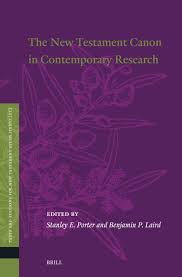
There is a recently published book we would like to call attention to, The New Testament Canon in Contemporary Research, ed. Stanley E. Porter and Benjamin P. Laird, Texts and Editions for New Testament Study 21 (Leiden: Brill, 2026). The book contains 23 essays within 9 sections on various aspects of the New Testament canon. The blurb for the book states:
The New Testament canon remains a major topic in scholarly research. This comprehensive volume provides a forum for scholars from varied backgrounds and perspectives to present major essays on the various dimensions of the topic. The essays are organized around three major foci: the formation of the canon, the components of the canon, and the witnesses of the canon, within which are several sub-sections. Following a treatment of various factors that prompted the formation of the New Testament canon, the subsequent sections include essays that present opposing views on specific questions of current debate.
The following is the Table of Contents.
Introduction – Stanley E. Porter and Benjamin P. Laird
Part 1 The Formation of the Canon
Section 1 What Were the Leading Factors that Prompted the Formation of the New Testament Canon?
Chapter 1 Inspiration and the Formation of the New Testament Canon – Michael J. Kruger
Chapter 2 Apostolicity and the Formation of the New Testament Canon – Benjamin P. Laird
Chapter 3 Catholicity and the Formation of the New Testament Canon – Tobias Nicklas
Chapter 4 The Rule of Faith and the Formation of the New Testament Canon – Tomas Bokedal
Chapter 5 Gnosticism and the Formation of the New Testament Canon – Dimitris J. Kyrtatas
Chapter 6 The Influence of Marcion on the Formation of the New Testament Canon – Markus Vinzent
Chapter 7 Conciliar Resolutions, Theological Disputes, and the Canon of the New Testament
– Mark Edwards
Section 2 When Did the Core of the New Testament First Become Recognized, and When Was the Complete New Testament Fixed?
Chapter 8 The Case for an Early Formation and Closing of the New Testament Canon – L. Scott Kellum
Chapter 9 “Canon,” “Scripture,” and the Function of the New Testament in the Life of the Church – Craig D. Allert
Section 3 What Was the Early Christian Perspective on Pseudepigraphy, and How Did the Practice Influence Canon Formation?
Chapter 10 Pseudepigraphy, Authorship, and Authority: The Historical Context of a Literary Phenomenon and its Impact on Canon Formation – Jeremy Duff
Chapter 11 Early Christian Perspectives on the Practice of Pseudonymity: The Evolution of Early Christian Thought – Lee Martin McDonald
Part 2 The Components of the Canon
Section 4 When and How Did the Fourfold Gospel Collection Gain Canonical Recognition?
Chapter 12 The Early Use of the Memoirs of the Apostles: Evidence for the Early Formation and Recognition of the Fourfold Gospel – Charles E. Hill
Chapter 13 The Use of Gospel Tradition in the Early Church: Evidence for a Prolonged Process of Canonical Recognition of the Fourfold Gospel – Jason David BeDuhn
Section 5 When and How Did the Catholic Epistles Gain Canonical Recognition?
Chapter 14 The Unity of the Catholic Epistles and the Formation of the Seven-Letter Corpus – Gregory Goswell
Chapter 15 Riddles and Relationships: On the Emergence of the Catholic Epistles Collection – Wolfgang Grünstäudl
Section 6 When and How Did the Pauline Epistles and Hebrews Gain Canonical Recognition?
Chapter 16 The Case for Pauline Involvement in the Formation of the Pauline Letter Collection – Stanley E. Porter
Chapter 17 The Canonical Paul and the Emergence of the Pauline Corpus: A Theological and Historical Assessment – Robert W. Wall
Section 7 When and How Did the Book of Revelation Gain Canonical Recognition?
Chapter 18 Seal Up and Do Not Read: The Rocky Path to Canonical Acceptance of the Apocalypse of John in the Eastern Orthodox Church – Eugenia Scarvelis Constantinou
Chapter 19 The Variegated Reception of Revelation: A Historical Survey of the Canonical Recognition of the Apocalypse – W. Gordon Campbell
Part 3 The Witnesses of the Canon
Section 8 What Do the Ancient Textual Witnesses Reveal about the Development of the Canon?
Chapter 20 Artifacts of the Canon: What the Textual Evidence May Reveal about the Early State of the New Testament – Hans Förster
Chapter 21 Scribal Practices and the Emergence of the New Testament Canon – Gregory R. Lanier
Section 9 What Do the Church Fathers Reveal about the Development of the Canon?
Chapter 22 Patristic Witnesses to the Canon: What Early Christian Writings May Reveal about the Development and Reception of the New Testament – Paul Foster
Chapter 23 Recognized and Functional Authorities of the Early Church and the Emergence of the New Testament Canon – Paul A. Hartog
Conclusion – Stanley E. Porter and Benjamin P. Laird
At over 650 pages, this book serves to be one of the most comprehensive books on the New Testament canon for study today. Make sure your local theological library
— David I. Yoon

