
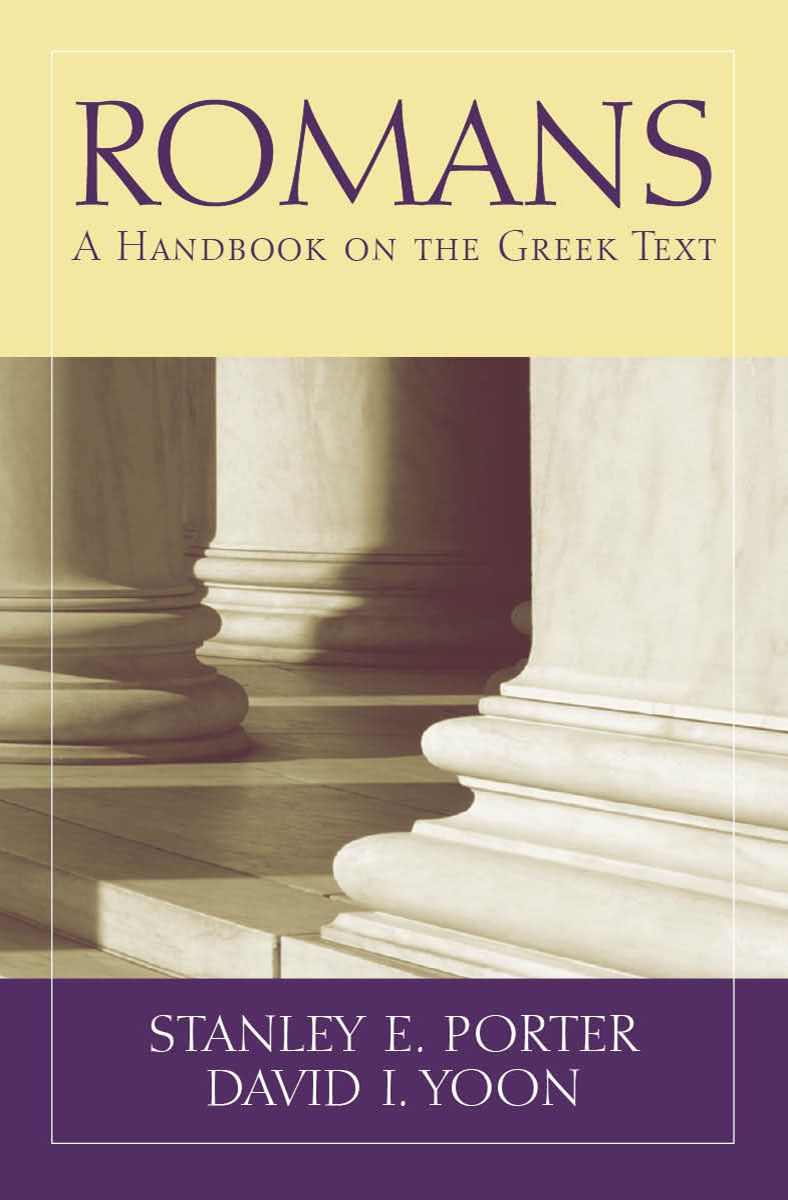
One of the last awaited volumes in the Baylor Handbook on the Greek New Testament series has been out for a short while now, co-authored by the two D33 bloggers, Stanley Porter and David Yoon, on Paul’s letter to the Romans.
The overview on the website states:
In Romans, Stanley E. Porter and David I. Yoon provide a foundational examination of the Greek text of Romans. The analysis is distinguished by the detailed yet comprehensive attention paid to the text. The authors’ exposition is a convenient pedagogical and reference tool that explains the form and syntax of the biblical text, offers guidance for deciding between competing semantic analyses, engages important text-critical debates, and addresses questions relating to the Greek text that are frequently overlooked or ignored by standard commentaries. Beyond serving as a succinct and accessible analytic key, Romans also reflects the most up-to-date advances in scholarship on Greek grammar and linguistics. This handbook proves itself an indispensable tool for anyone committed to a deep reading of the biblical text.
In the Preface, Porter and Yoon write:
In line with the commentary [Porter’s Romans commentary published with Sheffield Phoenix in 2015], this handbook not only focuses on meanings of individual words but incorporates discourse analysis (from a systemic functional linguistics framework). We believe that Greek analysis is not simply relegated to word studies, or even parsings of individual words, as valuable as these may sometimes be, but in observing how word groups, clauses, clause complexes, and other features make meaning in the text. We have attempted to instill this perspective in this handbook as well. We believe that the final product presented to our readers is a defensible explanation of the Greek text of Romans (xvii).
We hope that this handbook on the Greek of Romans will help both beginning students of Greek and advanced Greek scholars to think through the grammatical, lexical, and other linguistic features of Paul’s letter to Romans to better understand this important letter and its significance for the broader Church.
— David I. Yoon
 DOMAIN THIRTY-THREE